
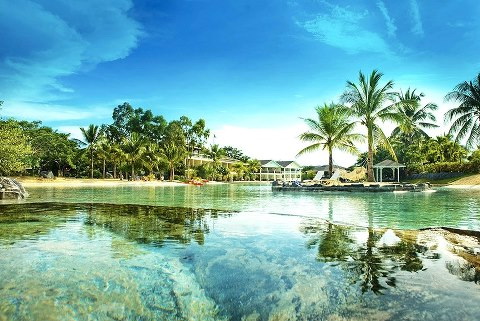

Gorgeous Cebu in the Philippines, with its crystal clear waters, perfect weather and warm, friendly, welcoming people. We loved our time there… but were also struck by the stark and unsettling contrasts.
It’s disturbing, the drastic imbalance between the opulent beachfront resort/ spa hotels where foreigners typically stay compared to the simple, local lifestyle just a few yards away, beyond the gated and heavily-guarded entryways.
As stunning and comfortable as our resort was, we always like to get a taste of the local community and culture – and ideally get fully immersed if possible.
Miniature goats frolicked in the streets and kids were everywhere – just wondering around unaccompanied in fact – from as young as about 2 years old (generally bearing an old T-shirt and no pants) up to about the age of 12. Most only spoke a word or 2 of English but were eager to surround the foreigner and offered up big, warm smiles. I did manage to speak with a gaggle of 11 year olds, and one girl spoke perfect English.
“Kumusta?”, I said. “Why aren’t you in school?”
It seems the teacher was sick so school was cancelled.
“How long have you been out of school? “
“About a week.”
Eek.
We noted the lingering influences of the Spanish colonial past. Some believe the less-than equal treatment of women is a result of the “macho” Hispanic influences, for example. Otherwise the local “kumusta” was reminiscent of the Spanish “cómo está.”; however the “fine” response couldn’t be further from any Spanish roots “mabuti”.
We met up with a Canadian guy married to a German girl, born in Hong Kong. They noted how they have visited Philippines often and it’s disturbing to observe how the locals live in such squalor. Expats in gated communities can’t have too nice of a house, otherwise, they’d be targeted for robberies. So their friends needed to downsize way below their means just to be safe. They take their laptops and cameras out in backpacks any time they leave. They won’t walk the dog after dark, for fear of leaving the house empty and for safety issues on the streets. Apparently crystal meth is the local drug of choice.
Housekeepers apparently make the equivalent of about 75 USD per month as an average decent salary. In Hong Kong they make 4 times that, and get room and board included.
There is no expat enclave, as often exists in other places. To enjoy the comforts offered by the Western-style resorts, expats purchase day-passes. Almost no public beaches; apparently only 2 on the island of Cebu and they’re not very nice. Most of the beaches are owned by the resorts, so exclusive – and the typical local will never set foot there.
Our friends also lamented the awful waste of the resorts the amount of food from the omnipresent and copious buffets that is thrown away on a daily basis could probably feed the whole island of locals. I wonder if anyone has every tried to develop a service to pick up the food and deliver to locals?
We appreciated the opportunity to explore a bit of Cebu outside of the expat bubble of the resorts, and look forward to coming back one day hopefully soon to delve deeper.
“Salamat”- thank you – my newly turned 10-year old daughter said to the lovely Filipino hostess at our resort. True to local hospitality tradition, the gorgeous-looking local lady put her hand over her heart, flashed a warm smile, and said “Walang anuman”, thrilled and beaming that a young American tourist would take the time to learn their language.
Third family member “down”, just one to go. Giada got her PADI certification for scuba diving following Hunter and Andrew so it seems inevitable that I will be next (my slight claustrophobic fears aside). Andrew and the kids had the great pleasure of exploring the inner depths of the South China Sea and the Philippine Ocean. Highlights included giant sea turtles, massive vibrant blue starfish, and a sunken old Roman wall!
A special shout-out is in order at this point for the lovely JD, a Swiss national, married to a local, who quit his high powered corporate job at DHL years ago and started up this fantastic diving school: Fun & Sun. Talk about a lifestyle change! Though admittedly making substantially less money, JD insists that the gains in quality of life make the choice a no-brainer.
The last day of diving is done – spectacular snorkelling for me – and my 11-year old says ”Halica dito”. It’s amazing how these kids retain new vocabulary, hard for my old and withered brain to fathom. When I try to remember the word for “come on, let’s go” in Tagalog, for some inexplicable reason, the only “word” that comes to mind is “wicky ticky”. Don’t ask me why. The brain is a strange and wonderful thing.
And so ends another exciting discovery of a new country, exposure to a warm and friendly community of people, a couple of vocab words in a new language, and a brand new scuba certification for our adventurous little girl!





No Comments